


- AI
- DevOps
- CI/CD
- Security
Related guides
Guide
DevOps trends 2025
Navigate the latest trends of AI-powered DevOps frameworks
Beyond the hype of Generative AI (GenAI) lies a significant opportunity and substantial challenge for businesses today.
While many are experimenting with chat-based tools and exploring their creative potential, harnessing GenAI for real business value requires a deeper, more strategic approach.
The use cases for GenAI are extensive and evolving rapidly. Today, these applications include generating text and code, utilizing internal documentation, and facilitating seamless, human-like interactions through customer support chatbots. But these examples only scratch the surface of what’s possible. GenAI will unlock even more transformative capabilities and previously unexplored opportunities as it matures.
However, achieving these benefits depends on a strong and adaptable DevOps framework enhanced by AI. Many successful companies carry a software legacy that is often retained in employees' minds and inadequately documented. AI-driven testing infrastructures now offer the ability to modernize these existing systems, revitalizing legacy software and enabling new avenues for platform development.
GenAI is in a rapid growth phase, marked by the frequent release of new tools, models, and solutions—which can feel overwhelming. So, how can forward-thinking organizations build the necessary awareness and leverage these technologies amid such constant change?
As we look ahead, emerging trends will shape how businesses approach these innovations. We hope this guide equips you to navigate these shifts, ask the right questions, and make informed investments for your company’s future.
Chief Technology Officer
Marko toimii Eficoden teknologiajohtajana. Eficode on eurooppalainen DevOps- ja design-talo. Hän on myös perustaja ja neuvonantaja useissa teknologia-startupeissa. Marko on intohimoinen ohjelmoija, joka uskoo, että design-järjestelmät ja jatkuva julkaisu (continuous deployment) ovat modernin kehitysorganisaation mahdollistajia.
Stay on this page to read the full guide or download it as a PDF for easy access anytime.

Bridge strategy with daily operations

Align central governance and local adaptation

Enables secure, traceable, and high quality services

Speeds up development and business innovation

Links products and customer success together
5 trends of 2025
Anything that’s real-time and collaborative-friendly is an advantage.”
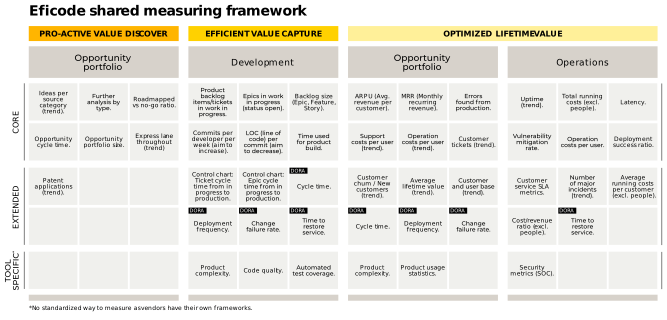
Real-time insights bridge the gap between strategic initiatives and daily operations. By applying DevOps practices, we have never had more data to steer business, invest in strategic initiatives, and create space for innovation and experimentation. Integrating real-time data analytics across the enterprise with AI-driven dashboards enables organizations to make informed decisions that align with long-term goals and immediate needs. With this approach, leaders can monitor KPIs at scale and adapt quickly to evolving business conditions.
Harnessing real-time insights ensures strategic objectives remain actionable and relevant, fostering an environment where data is collected and transformed into meaningful, actionable intelligence.
This capability helps teams stay aligned, reducing the friction of silos and promoting true cross-functional collaboration. As AI agents become more embedded in analytics platforms, they can provide predictive insights, alerting teams to emerging trends or potential issues before they impact performance. Real-time insights become a cornerstone for bridging strategy with daily operations, allowing organizations to remain Agile and proactive.
As toolchains centralize, development decentralizes.”

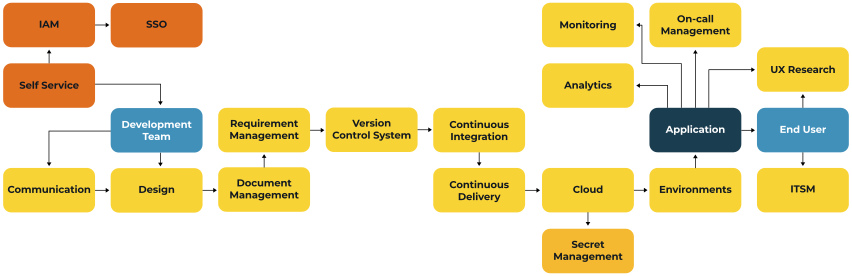
A consolidated toolchain is crucial for aligning central governance with local adaptation. In today’s complex technological landscape, organizations often struggle with fragmented toolsets that lead to inefficiencies and inconsistencies. Organizations can enforce central governance by adopting a unified, standardized toolchain while allowing room for localized customization and flexibility.
Central governance ensures best practices, compliance standards, and security protocols are uniformly applied across the organization. This consistency fosters trust and reliability in development and operational processes. Meanwhile, local adaptation allows teams to tailor tools to their specific needs, enhancing productivity and innovation at the local level.
Consolidated toolchains empower organizations to balance overarching control and the Agility required to meet local demands.
Teams spend 55% of their time on tooling: Streamlining toolchains can free up significant time, allowing teams to focus on core development and innovation.
Cloud-based end-to-end DevOps solutions enable security and compliance: These solutions ensure security and compliance standards are met without compromising development speed.
Consistent onboarding and training: Unified toolchains simplify the onboarding process for new team members, reducing the learning curve and improving productivity
Reduced shadow IT: A consolidated toolchain minimizes the use of unauthorized tools, ensuring that all workflows adhere to company standards and security protocols.
Improved collaboration and integration: Standardized tools allow cross-functional teams to collaborate more effectively, ensuring smoother integration between development, operations, and business units.
Having a consolidated toolchain is crucial for aligning central governance with local adaptation. Organizations today often struggle with fragmented toolsets that lead to inefficiencies and inconsistencies. By adopting a unified, standardized toolchain, companies can enforce central governance while allowing room for localized customization and flexibility.
By building a company-wide toolchain, this large commercial vehicle manufacturer was able to consolidate their tooling by over 40%. Watch now.
Everyone’s been racing to build their own thing, and now we’re stuck managing a chaotic mess. Turns out, moving to one solid toolchain is way cheaper than paying the price of endless fragmentation."

Stay on this page to read the full guide or download it as a PDF for easy access anytime.
DevOps doesn’t just work; it works better.”
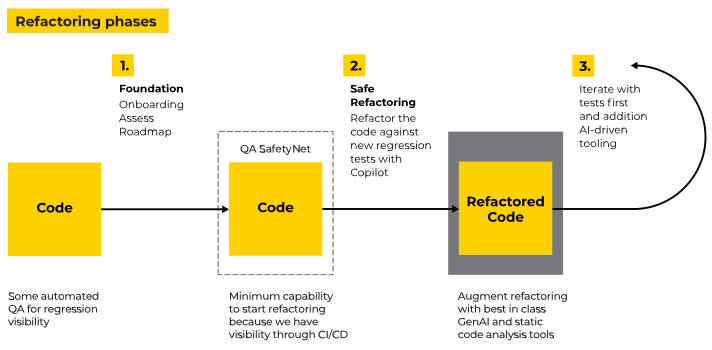
Never before has the need for the DevOps safety net been more critical. Delivering secure, traceable, and high-quality services in a highly competitive environment requires an investment in DevOps practices. As AI and automation play a larger role in development pipelines, ensuring these processes' confidentiality, integrity, and availability becomes critical. A DevOps safety net involves clear protocols for various types of test automation, safe deployment methods, continuous monitoring, and anomaly detection to prevent disruptions and maintain service quality.
In practice, a DevOps safety net includes:
Automated unit and integration testing: Ensures code changes are tested automatically before merging, reducing the risk of introducing defects.
Continuous Deployment pipelines with rollback mechanisms: Allows safe deployments with the capability to revert changes instantly if issues arise, for example, by using feature flags.
Canary releases and blue-green deployments: Safeguard production by deploying changes incrementally or in parallel, enabling validation in a controlled environment.
Real-time monitoring and alerts: Keeps teams informed of system performance and errors as they happen, allowing for quick responses to potential issues.
Secure code scanning and compliance checks: Automated checks for security vulnerabilities and compliance standards are integrated into the pipeline, ensuring releases meet security requirements.
This safety net enables teams to move quickly without sacrificing security or quality, ensuring every change, from code commits to infrastructure adjustments, is validated against stringent quality standards. By incorporating AI into these safety measures, organizations can preemptively identify vulnerabilities and reduce the risk of failure. The DevOps safety net supports continuous improvement, enabling organizations to iterate and deploy new features confidently.
In this podcast, DevOps’ proactive role as a safety net in integrating AI is discussed, emphasizing security measures to manage risks.
A DevOps safety net is the foundation where AI, security, and innovation come together to minimize risks and deliver business value quickly through reliable and sustainable processes.”
When you really accelerate with AI, you won’t be left in the dust”

AI-driven tooling accelerates both development and business innovation by automating complex tasks, providing intelligent code suggestions, and facilitating rapid prototyping. AI-driven platforms empower developers by reducing manual workloads and offering previously inaccessible insights.
The introduction of AI into development environments transforms the way teams build and deploy applications. From enhancing code quality to speeding up debugging processes, AI-driven tools help maintain high productivity levels and foster a culture of continuous learning and innovation. For business leaders, this translates to faster time-to-market, more robust products, and a stronger competitive edge.
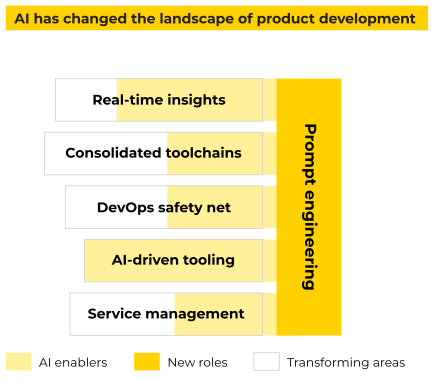
As AI tools evolve, their role in fostering collaboration and communication will become even more significant. They will break down barriers between development, operations, and other business functions. Integrating AI-driven tooling can bridge the gap between technical execution and strategic goals, driving innovation at an unprecedented pace.
Read this white paper to gain insights on AI’s dynamic and rapidly evolving nature.
I see AI-driven tools as a way to truly empower teams to focus on what matters most—creating value and solving meaningful problems. By integrating AI into workflows, we lower cognitive load, encourage innovation, and foster a culture where teams can experiment, collaborate, and deliver greater outcomes."

By incorporating AI into ITSM and ESM platforms, you can improve operational efficiency and enable your organization to deliver higher-quality and more proactive services.”

Service management is key to achieving customer success. In a landscape driven by digital transformation, service management encompasses a range of practices that ensure the delivery of high-quality, customer-focused services. Effective service management integrates AI and automation to streamline processes, improve response times, and enhance user satisfaction.
A modern approach to service management leverages real-time monitoring, automated workflows, and AI-powered analytics to anticipate customer needs and optimize service delivery. This approach ensures services are reactive and proactive, adapting to user expectations and market shifts. By focusing on comprehensive service management practices, companies can build customer trust and foster long-term relationships that contribute to sustained business growth.
Integrating AI and service management strategies creates a synergistic effect where customer feedback, operational data, and business goals align seamlessly. This allows organizations to stay ahead of the curve, delivering consistent, high-quality service and reinforcing a culture centered on customer success.
Service management isn’t just about keeping the lights on for us anymore—it’s about creating systems that let the whole business shine. By moving beyond support to driving real value, it’s become the backbone of how we innovate and stay ahead."
Stay on this page to read the full guide or download it as a PDF for easy access anytime.
Conclusion
Navigating the shift GenAI will create in 2025 will be critical for any organization looking to stay on top. and our DevOps trends will help pave the way for these innovations. Ultimately, a robust, adaptable DevOps framework enhanced by AI will be the key to unlocking your potential.
By mastering these trends and asking the right questions, your organization can fully utilize the transformative and exciting opportunities GenAI will provide as it matures.
Real-time insights
Consolidated toolchains
DevOps safety net
AI-driven tooling
Service management
When teams struggle with delivery, I look at their Developer Experience. With the right tools and support, even the toughest bottlenecks can become breakthroughs. If clients feel like they’re endlessly fixing the same issues, it’s often a sign of stronger DevEx and strategic automation.
For those overwhelmed by compliance or security issues, “We are a special case” is the most common thing I hear. Agile was never intended to mean everyone does things differently with different tools. I often recommend consolidating into GitHub or GitLab to simplify workflows, onboarding, and cross-department collaboration. Separate tools create silos, which only add complexity. A unified toolchain allows compliance to be seamless and traceable.
When I hear an organization is highly reactive or struggling to deliver, I work to bridge their strategy with real-time data in daily operations, making their vision visible and actionable across teams. Real-time insights bring clarity, identify trouble spots, and unite dispersed teams so everyone can see their part in the bigger picture. With quality concerns, AI implementations, or legacy issues, I focus on establishing a DevOps safety net so teams can work quickly and confidently with secure, high-quality services. AI-driven tools can be transformative when innovation stalls, freeing teams to pursue breakthroughs.
If customer satisfaction is slipping, I guide clients toward service management focused on customer success—keeping value front and center at every touchpoint. There’s an important end-to-end approach here: Solving root issues is the only way to help clients achieve lasting change.
Principal Consultant - Eficode
Marc helps organizations improve software delivery by connecting strategy, Developer Experience, and practical automation. He works with leaders to reduce complexity, strengthen compliance, and turn operational insight into faster, safer delivery and lasting customer value.
We’ve never had more information or powerful tools to steer our business. I see real-time insights as essential for enabling companies to make swift, informed decisions about where to invest and why. Organizations often struggle to achieve end-to-end visibility in their delivery pipelines and operations, leading to delays in detecting issues or optimizing processes. Our priority is to help our clients implement systems that gather data and contextualize it for actionable insights, ensuring bottlenecks and inefficiencies are immediately visible and actionable. This need aligns with the growing demand for dashboards and observability tools that empower business to act proactively rather than reactively.
Centralization of governance, security, and compliance allows for more decentralized and empowered development. In consolidated toolchains, the focus would be on simplifying complexity through centralization. Many clients suffer from tool sprawl, creating integration headaches and fractured workflows. A streamlined toolchain that integrates seamlessly across teams can reduce operational overhead and foster decentralized, empowered teams that collaborate even more. For a DevOps safety net, the lead would recognize the importance of ensuring reliable rollbacks, robust testing, and system monitoring as a foundation for faster delivery without compromising stability—more speed with less risk means we can try more business ideas than ever. Meanwhile, AI-driven tooling would represent a growing opportunity, with the lead identifying potential for automation in code quality checks, resource scaling, and incident management. Lastly, service management would emphasize aligning IT operations with business priorities, helping clients evolve traditional ITIL practices into faster, DevOps-compatible frameworks that ensure uptime and service quality across hybrid infrastructures.
Chief Product and Partner Officer
Henri helps organizations to become successful and more efficient. As a hands-on consultant, he brings about necessary organizational changes improving their structures, processes, tools, and working methods. His extensive experience spans coaching tens of different kinds of product organizations.
Ready to make AI work for your DevOps?
Learn moreRelated guides
Want to build a more secure, efficient DevOps approach with AI?
Our experts can help you identify the right tools and practices for your organization.


