



- Agile
- Product management
Related guides
Guide
The Scrum Master's startup guide
What you need to know to get up and running as a Scrum Master
If you are starting out as a Scrum Master, or face some of the Scrum Master's responsibilities, this guide gives you a basic understanding of your work and how to get going. Most Scrum Masters assume this role in addition to their normal "day job". This guide is perfect for them.
In many cases, Scrum Master can also be a full time role. But in those cases, full-time the Scrum Master often takes care of several scrum teams.
Much more often, Scrum Master is a role that someone in the development team takes on in addition to their normal duties. As a part-time Scrum Master, you will probably dedicate only 5-10% of your time to your Scrum Master duties (this does not include participation in the team ceremonies, which all team members naturally participate in).
If you are just starting to work as a Scrum Master, part-time while you continue your other duties: this guide is especially for you.
But it is also a great resource for teams who decide to rotate the scrum mastership between from team members.
No need to rush in to book a seat on a "Certified Scrum Master" two-day course. You can get up to speed and be an effective Scrum Master in just a couple of hours. So let's get to it!
For easy reading, receive this guide as PDF by e-mail
1. Why Agile?
With effective Agile methods and scrum, your team performs better and will experience less stress. The team will improve and work in a more sustainable way, for longer periods of time, without the need for overtime.
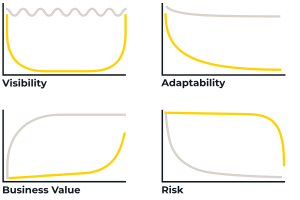
You will benefit in the following ways:
See better, how the work is progressing
Adapt better to unexpected changes in your environment
Deliver business value faster
Significantly lower your risk
Additionally, your key stakeholders are more happier because:
Customers are more satisfied
Management are more satisfied
Employee are more satisfied and team spirit is higher
2. Manifesto
Our highest priority is to satisfy the customer through early and continuous delivery of valuable software.
Welcome changing requirements, even late in development. Agile processes harness change for the customer's competitive advantage.
Deliver working software frequently, from a couple of weeks to a couple of months, with a preference to the shorter timescale.
Business people and developers must work together daily throughout the project.
Build projects around motivated individuals. Give them the environment and support they need, and trust them to get the job done.
The most efficient and effective method of conveying information to and within a development team is face-to-face conversation.
Working software is the primary measure of progress.
Agile processes promote sustainable development. The sponsors, developers, and users should be able to maintain a constant pace indefinitely.
Continuous attention to technical excellence and good design enhances agility.
Simplicity – the art of maximizing the amount of work not done – is essential.
The best architectures, requirements, and designs emerge from self-organizing teams.
At regular intervals, the team reflects on how to become more effective, then tunes and adjusts its behavior accordingly.
For easy reading, receive this guide as PDF by e-mail
3. Scrum
Scrum is based on the three principles of Transparency, Inspection, and Adaptation.
this means for example, that no work, specification, problems, risks or progress of work is hidden. Everyone on the team and outside must have access and visibility of how the work is proceeding.
this means that the team is motivated and willing to look at the results of the work, and the process that created it – and then analyze the result and compare it to what the team wants to achieve.
this means that the team actively seeks to adjust course based on what it feels is the correct direction to take.

All team members contribute to the target. Collaboration and other's ideas are respected. Other people's accomplishments are celebrated.

Team members are honest when they need help. An open-minded team always seeks to improve and learn. Ceremonies like daily and review show clearly and openly how things went. Assumptions are voiced out loud.

The team is protected from sprint scope changes, and the sprint planning session seeks opinions from the team to deliver. In the daily - the team feels pressure to deliver promise.

The team finishes what they start and does not get sidetracked.

Question the status quo, feel safe to ask for help and say no. The team does not fear difficult conversations.
4. Ceremonies
Agile ceremonies are meetings that happen regularly on a weekly, daily or per sprint frequency. The content and format of the meeting varies very little. The ceremonies are an integral part of the Agile way of working. Ceremony facilitation and improvement usually is the responsibility of the Scrum Master.
Scrum uses all the below ceremonies. Kanban uses four of them, but lacks sprint planning and review because Kanban does not have sprints. Kanban teams must have another frequency to discuss items that fall into sprint planning and review agenda.
Regular meeting to improve the top of the backlog, and maintain the rest of it.
At the start of sprint, the team and product owner get together to plan and commit what can be done in the coming sprint.
A short, daily meeting where the team self-organizes what has been completed, what is started next, and keeps work going forward.
Regular meeting that reflects on past work, and finds better ways to do things.
At the completion of the sprint, the team and PO get together to review done and not done items, and also reflect on learnings and the big picture.
The team presents complete work to stakeholders to get feedback.
The ceremonies in Agile
Agile ceremonies are meetings that happen regularly on a weekly, daily or per sprint frequency. The content and format of the meeting varies very little. The ceremonies are an integral part of the Agile way of working. Ceremony facilitation and improvement usually is the responsibility of the Scrum Master.
Scrum uses all the below ceremonies. Kanban uses four of them, but lacks sprint planning and review because Kanban does not have sprints. Kanban teams must have another frequency to discuss items that fall into sprint planning and review agenda.
For easy reading, receive this guide as PDF by e-mail
5. Checklist
The most important things to do as new Scrum Master are:

Read this guide completely.

Find and bookmark the scrum guide and read it the first time(you should return to it regularly to reflect on your skills and progress).

Agree with your Product Owner on who will invite to the team ceremonies. (If you don’t know who the Product Owner is, talk to your manager and halt the process here while you get a name.)

Book all the team ceremonies. Make the ones that can regular and recurring (which is most of them), in the calendar invitation, and book the necessary meeting rooms or video call arrangements.

Ensure you and your team are well prepared for your first round of team ceremonies with instructions from this guide.

Enjoy your Scrum Master role! You are a key player on your team’s road to successful scrum!
Whichever level Scrum Master you are, our seasoned Agile experts are available to help you to the next level and beyond.
Get in touchRelated guides
Whichever level Scrum Master you are,
our seasoned Agile experts are available to help you to the next level and beyond.


