

- Agile
- Product management
Related guides
Guide
Improving your Agile ceremonies
Learn how to evaluate your Scrum or Kanban ceremony practices and start improving now
Team ceremony quality has a huge impact on team morale, spirit and productivity.
A team with good quality Agile ceremonies implements the right things, correctly, with few change needs down the road. It is also able to listen to customer and stakeholder feedback and react quickly.
Improving the ceremony practices has high return on the effort invested. But the changes don't appear overnight. The team must improve things slowly and take the new elements of ceremony practice into use and build them into positive habits, if they suit the team.
This guide helps the team and the team coach (usually Scrum Master) accurately evaluate current ceremony practices, and allows them to choose new elements to try to improve team performance.
This guide is meant for the team coach and team itself to assess the current level of ceremony practices and choose new elements to try. In this sense it acts as a map to higher levels of ceremony practices. The guide is meant for teams that are using either a Scrum or Kanban way of working.
Read the full guide on this page, or get a PDF copy sent to your email for easy access anytime.
Read the guide completely.
Together with the team, assess your current ceremony practices for each of the six ceremonies. Use a workshop or the printable questionnaires at the end of the guide for this.
Choose the ceremony in which your team finds most room for improvement.
Within the team, discuss elements from the current and next levels of ceremony practice. Choose one, or maximum two, elements for testing in upcoming ceremonies. Use the checklists at the end of this guide for team review of each ceremony.
Allow a few times to test the new elements. Then assess if they worked or need adjustment, or if you did not feel they offered benefits. Repeat steps 3–5.
Improvement of the ceremony practice does not need to stop, ever. You can focus more energy on it in the beginning, but a good team never stops seeking ways to improve.
1. Agile ceremonies
Agile ceremonies are meetings that happen regularly on a weekly, daily or per sprint frequency. The content and format of the meeting varies very little. The ceremonies are an integral part of the Agile way of working.
Ceremony facilitation and improvement usually is the responsibility of the Scrum Master.
Scrum uses all the below ceremonies. Kanban uses four of the them, not the sprint planning and review, because Kanban does not have sprints. Kanban teams therefore need another frequency to discuss items that would otherwise fall into sprint planning and review meetings.
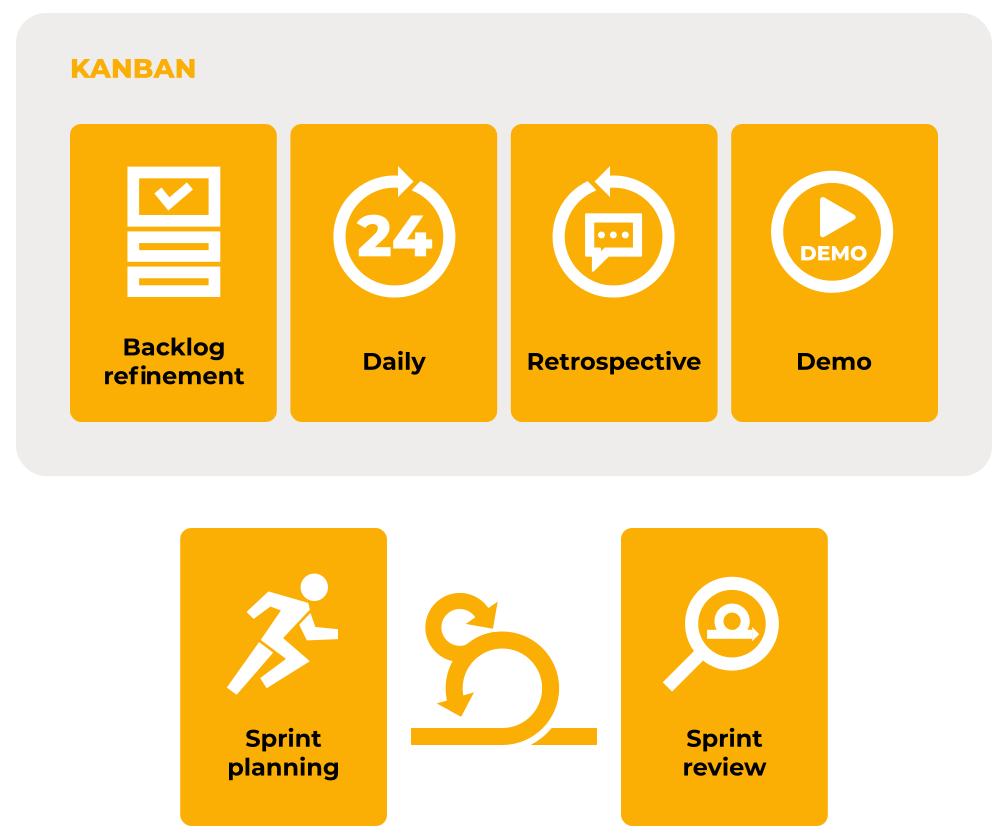
Regular meeting to improve the top of the backlog, and maintain the rest of it.
At the start of sprint, the team and product owner get together to plan and commit what can be done in the coming sprint.
A short, daily meeting where the team self-organizes what has been completed, what is started next, and keeps work going forward.
Regular meeting that reflects on past work, and finds better ways to do things.
At the completion of the sprint, the team and PO get together to review done and not done items, and also reflect on learnings and the big picture.
The team presents complete work to stakeholders to get feedback.
2. Improve your ceremonies
Improving ceremonies leads to a rise in overall team productivity. This is a direct result of doing more things right the first time, and getting better feedback to further improve the backlog item priorities and clarifying the descriptions.
The feeling of success and a less stressful work environment leads to less employee churn, and increased team stability and learning potential.
Finally, a well-working team sets an example in the organization and leads to more career opportunities for all people involved.
Less stress
Less employee churn
Happier stakeholders
Faster implementation
Happier customers
Increased learning
More motivated team
Power of example
Career improvement
For easy reading, receive this guide as a PDF by e-mail
Ceremony-specific benefits

Better quality backlog items arrive for sprint planning, faster sprint planning meetings, more accurate sprint content loading, more accurate effort estimates, and better release scope control.
Less sprint spillover, more accurate estimates, better demo, and more self-organized teams.
Less sprint spillover, more info sharing, less knowledge silos, smoother task handovers, and better risk management.
Improved team performance, spirit and motivation over time, and increased learning.
Better feedback on backlog from completed work and learnings from current sprint. Maintaining complete big picture overview of the project.
Accurate feedback for the team from stakeholders. Increased directional control for product development.
3. Where to start
We want you to turn your ceremonies into "super ceremonies", where you operate at a completely new level. But it doesn't mean you combine the different ceremonies into one. Because they each fill a crucial role, and perfection comes from experimenting with them separately.
Good rules of thumb

Regularly at the same time every week. 1 hour event. Arrange additional events when the backlog inflow seems higher.
1-3 hour event. On the first day of a new sprint. Do not end sprints on a Friday.
Max 15 min every day. Follow up with specific meetings on identified topics.
Regularly every 2-4 weeks. Book time slots in advance. 1 hour event.
1-2 hour event. On the last day of sprint.
30-60 minute event. Arrange near the end of a sprint, or at other times based on availability of stakeholders.
For easy reading, receive this guide as a PDF by e-mail
When and how long
4. Find your level
Find your level
Backlog refinement

The team runs the risk of accepting backlog items into a sprint backlog with unclear descriptions, leading to slow implementation and more errors and changes later. The backlog will not be prioritized or kept clean of trash stories. Difficult to estimate or prepare for work beyond next sprint.

Regular refinement sessions clarify the backlog items. The product owner is better able to prioritize backlog items both in the refinement session and outside it. Refinement actions focus on items in the next sprint and slightly beyond.

The team actively uses “Definition of Ready”. Size limits are set to guide item splitting. Complex items are identified in the backlog and prepared separately, outside the refinement session. Refinement actions focus on the next 1-2 months of backlog.

The backlog cleanup is done regularly. The team actively uses different splitting methods and the INVEST model for user stories. Common refinement sessions with other, dependent, teams are arranged. Refinement actions span beyond the next 1-2 months of backlog, stretching to 12 months as rough refinement.
Find your level
Sprint planning
It is a rare that a Scrum team does not use the sprint planning ceremony. If it doesn’t, that probably means there are no sprints – meaning that the team uses pure Kanban.
The product owner brings a proposal of sprint content to the planning meeting, and the top of the product backlog is also prioritized to allow change to this proposal. The team can negotiate and adjust the content of the sprint, depending on velocity. Stretch goals may be in use. Definition of Done is written and in use.
Sprint goals are defined. “Definition of Ready” is used as a last gatekeeper to accept content into the sprint backlog. The sprint simulation is done to balance load and to sanity-check the sprint content. Customer need, and acceptance criteria are actively discussed for all items.
Demo planning is started at sprint planning. High-risk items and items that require mid-sprint direction validation are identified. The big picture and vision is kept in mind during the event.stretching to 12 months as rough refinement.
Find your level
Dailies
The team can’t reach sprint goals effectively, and will struggle to implement the most important things from the sprint backlog. Calls or offers for help are often disregarded, and the team members work more in isolation. Self-organized teamwork is difficult.
The daily occurs several times a week, and is not longer than 15 minutes. The basic format is: Yesterday, Today, and Impediments.
The daily is driven by the team itself, not by the Scrum Master. The Scrum Master is an observer. Learnings are shared when needed. People see the end of their current task and discuss optimum next item from the backlog. ”Ah, good thing we had this meeting” moments are common. The daily leads to active helping of other team members.
The team has full ownership of the daily, and considers progress toward sprint goals. Items that are done are celebrated! Impediment solving is assisted by the daily and stuck team members are helped even if they did not ask for it.
Find your level
Sprint review
The team does not learn why certain tasks were and were not completed. The big picture (schedule, deadlines, budget) remains unknown.
Task completion is reviewed. Not completed items are moved to the next sprint.
The product owner approves deliverables. The items that are done are regularly checked against “Definition of Done”. The team analyses why some items were not finished. Sprint learnings and backlog adjustments are done.helping of other team members.
The product owner can approve items mid-sprint. The team considers the sprint’s impact on the big picture, and risks and mitigation plans are actively reviewed. Reports to stakeholders are considered.
Find your level
Retrospective
Improvement of the ways of working is slow or nonexistent. Team performance is static at a certain level.
Regular retrospectives are in use and result in discussion, identification of improvement items, and action points. Action points are assigned an owner.
Meeting time is managed to allow good root cause analysis and action planning. Previous action points are followed up. Action points may be loaded into the sprint backlog, to give the team ”permission” to work on them immediately. Different retrospective methods are trialed, and vary. Sometimes the retrospective has a specific theme.
Retrospectives are used to improve all Agile ceremonies regularly. They don’t always have the same host, and are sometimes held with other teams to improve the program or organizational cooperation. Futurespective methods are used regularly. The team expands its influence beyond team.
Find your level
Demo
Feedback from items is missing, and this can result in changes or reported errors later. Increased risk that the product increment is not being releasable to production.
The demo is a separate session from the sprint review, and regularly gets stakeholders to participate. Feedback is received and reflected in the backlog.
Different people present demos. Demos are tied to the big picture of the release or product vision. The demo is based on a prepared script, and leads to active discussion.
Different methods (different demo sessions, recordings, email, screenshots) are used to maximise feedback. The demo session is also used to celebrate successes and enhance the team’s feeling of achievement.
For easy reading, receive this guide as a PDF by e-mail
5. Ceremony checklists
Team development requires management support and a team coach who understands the principles of coaching, and has time and motivation to develop the team to a higher level of performance. The best results always come with a good internal coach. Scrum masters and line managers are suitable roles and positions to be team coaches. The development of ceremonies is a long journey. You will get results fast, but remember: it doesn't stop there.
Agile super ceremonies:
Backlog refinement
Regular refinement sessions 2-4 times a month
Product owner has been selected
Backlog exists, and some effort to prioritize it has been done
Backlog items that have been refined and have more than just a title in writing (i.e. at least a simple description)
Effort estimation is in use
Refinement focuses on the next sprint only, not beyond that
Definition of Ready has been defined, and is actively used
Team discusses and defines customer need or value for each backlog item that is refined
Acceptance criteria are in active use
Refinement session has timeboxes per item
Testability and automatic testing are considered
Complex items are prepared off- session and presented to the team / studied in take-a-bite manner
Discussion is active, nobody dominates it, and the discussion is documented to the backlog item
Team has a size limit for too large stories, and regularly splits stories in refinement session
Refinement focuses on content for next 1-2 months
Backlog priorities and trash item cleanup is done regularly
Forward planning for items that require longer feasibility studies are actively planned
Active use of the INVEST model for user stories
Balance between too little – too much detail
Team actively does rough refinement of future items (beyond 2 months)
Team considers assumptions and story risk and uncertainty, as well as dependencies to other teams or outside team factors (for example environments)
Alternative solutions to build are considere
Common refinement sessions with other teams when doing dependent items
Advanced item-splitting techniques
Active development of estimation skills
Agile super ceremonies:
Sprint planning
Separate sprint planning meeting is held at start of sprint
Top of the backlog has been pre-prioritized by product owner
Team selects items from top of the backlog until it feels that enough work has been chosen for sprint
Team creates tasks for items that it plans to start with
Team may choose to use stretch goals for sprint
Definition of Done is written, understood by team, and actively in use
Only items that pass team Definition of Ready are approved to sprint backlog
Most items chosen for sprint are pre-refined and pass Do
New items that do not pass DoR are refined in the planning meeting until they pass DoR
New items that do not pass DoR are refined in the planning meeting until they pass DoR
Team does a sprint simulation to balance load, plan initial few days
Team identifies when it has overcommitted in past sprints, and adjusts sprint scope
Discussion about the chosen content is active, especially about customer need, effort estimation and acceptance criteria
Team considers capacity spent by not completed items from previous sprint that are decided by team and PO to be continued in this sprint
Team considers capacity impact of training, holidays, etc.
Team doesn’t approve backlog items larger than team limit to be single sprint backlog items (without splitting)
Team uses sprint goals
Items to be potentially demoed at end of sprint are planned in the session
Items from sprint backlog with high risk and uncertainty are identified
Team remembers the big picture, product vision, release vision and considers how the chosen work ties into that
Members volunteer for items that encourage learning new things
Team finds a timebox for Sprint planning that works best
Team is able to re-order implementation of sprint backlog items to find best possible way to achieve the sprint goals (and completion of the chosen tasks)
Agile super ceremonies:
Daily
Daily occurs several times a week and is timeboxed to less than 15 minutes
What I did yesterday, what I am going to do today, issues
Daily occurs daily, even when scrum master is not present
What have I learned that others really should know?
When is my current task ready for next step?
Team members really listen to each other
What is started next? Team considers sprint backlog priorities.
Usually at least one “ah, good thing we had this meeting” moment
Frequent follow-up meetings for issues identified in the standup
Feedback is heard and responded to
Team has ownership of the daily ceremony (with or without Scrum Master)
Team considers progress toward sprint goal and sprint backlog completion
Celebration of achievements
Team notices when someone is stuck, but is not saying it out loud
Offers for help are heard and accepted
Team is cognizant of risks in the sprint backlog items and knows when to act
Agile super ceremonies:
Retrospective
Retrospective is held regularly
Retro results in some action points
Action points have a named owner
Product Owner may participate (but as a normal team member – not a PO role)
Previous retrospective action points are followed up
Retrospective action points are loaded to next sprint as sprint backlog items, and treated as any other story chosen for sprint (DoR, refined, effort estimated, tasked)
Retrospective methods are trialed and changed occasionally
Different themes or focused topics are used occasionally
Team understands what kind of things are under its influence, and agrees on actions that it can carry out on its own
Retrospectives are hosted in a manner that allows focused discussion, root cause analysis and action planning
Different ceremony practices are improved in focused retrospectives
Retrospective host is changed occasionally, or hosts are rotated
Retrospectives are also held together with other teams
Team finds ways to influence issues that are outside its direct sphere of influence, for example by setting example, building organizational influence by active participation in communities, or by employing chain of command
Retrospective issues that remain a “constant” but are unpopular in team voting are addressed to solve issues that bother only a few participants
Team also regularly uses “futurespective” methods such as pre-mortem
Agile super ceremonies:
Sprint review
Review is separate section or separate meeting from Demo
Items that are done are closed
Items that are unfinished are moved to next sprint or back to backlog
Product owner approves items in review
Team analyses “Done” items: Did they pass DoD? Did they pass NFRs
Do they fulfill the customer need, as understood now? Is anything else needed related to this customer need? (added to backlog)
Inspect the potentially releasable increment
Team analyses the unfinished, non- stretch goal items: Why weren’t they finished? Blocked or overcommitted?
Team discusses sprint learnings: Backlog priorities need re-adjusting? New items for backlog or for next sprint content proposal? Some items in backlog are not needed based on learnings for this sprint
Product owner can approve work also in mid sprint, not only in review
Project risks and mitigation action plans are considered
Project big picture, budget and schedule are reviewed and updated
Team identifies stakeholders who need additional information about progress, and finds way to get it to them
Agile super ceremonies:
Demo
Demo is a separate section or separate meeting from Sprint review.
Stakeholders are invited to participate in the demo session
Demo is not shown from developer machine or branch, but checked in codeline branch
Demo audience is given opportunity to give feedback
Demo script is planned beforehand
Common, easy-to-understand language is used
Team rotates between different demo presenters: PO, dev, tester, stakeholder, customer support...
Presentation of how the demoed feature ties into the big picture
Demo script and item planning is started already in refinement or sprint planning
Some stakeholder groups get a different demo from others (i.e. business demo once every 1-2 months, sprint demos at end of each sprint)
Demo leads to discussion or follow-up meetings after feedback; PO documents insights
APIs are demoed with dev or test tools, that are also available for others
Customers or stakeholder reps are encouraged to try out the feature themselves
Separate recordings or demo sessions are arranged for stakeholders who can’t join the main session
Demo session also celebrates work done and achievements. Team feels sense of accomplishment after the demo.
Stakeholder opinions are not “message from god” but are feedback as any other. Team may choose to not consider these as “the one truth” and can challenge them. Demo is a place for collaboration – not reporting.
Take your Agile ceremonies to the next level
Contact usRelated guides
Whichever level you are at with your Agile ceremonies,
our Agile experts are ready to take you to the next one.


