How to pass ITIL4 Foundation: A fairytale guide

If you are like me, who has serious attitude problems when it comes to fixed frameworks and memorizing schoolwork, this blog is for you to learn ITIL4. Who wouldn’t love a fairytale?
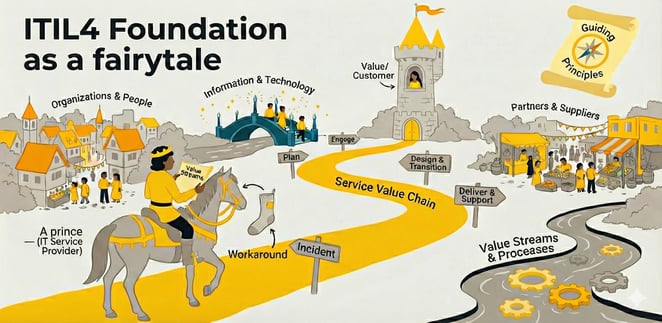
Once upon a time, like a month or two ago, I was studying for the ITIL4 foundation certificate exam. Memorizing the differences between “fit for use” and “fit for purpose” and trying to figure out how all the models overlap and interact with one another. Besides visualizing them as one, I needed to create a story that entailed a task (a challenge turned to a triumph), a storyline with happenings (beginning, middle, end), and a theme (how the story was built). So…
The fairytale-to-ITIL legend
|
Fairytale element |
ITIL4 concept |
|
The prince |
Service provider |
|
The princess |
Service consumer |
|
The marriage |
Outcome |
|
The map |
Value streams |
|
The Kingdom's approval |
Governance |
|
The horse |
Partner |
|
The dragon |
Emergency change |
|
Holey socks |
Problems |
|
Gluing the sock |
Workaround |
|
Animals in the jungle |
Feedback loops |
The four dimensions of Service Management: The quest for love
Once upon a time, a prince looked for love (demand) and decided to start a journey to get to a princess (output). They wanted to get married (outcome) and acquire half a kingdom (just a bonus for extra customer experience). To get to the princess, the prince had to tackle several challenges.
The prince knew that to succeed, he needed to evaluate Political (there’s always politics!), Environmental (rain or shine?), Social (he was a prince, not a peasant), Technological (the road was viable), Legal (they were of legal age), Economical (he had a chest full of treasures) situation.
On an inner layer, he needed to ensure his and her kingdom’s approval for the quest (organizations & people); he had the sword and a John Keats’ poem ready (information & technology); the meals were prepared and shoes polished by the staff (partners & suppliers); the road on the map in his hand was clear (value streams & processes).
In any situation, it is important to understand and evaluate the factors affecting the project, e.g., using systems thinking or stakeholder mapping.
The service value chain and governance: The prince’s assets
The prince was quite systematic in reaching the value, love, he was after. He worked through six interconnected activities: He planned the trip to achieve the desired outcome. He engaged the necessary helpers from chefs to farriers. He designed and transitioned himself with assets towards the obtain/build to take the journey, after which the delivery and support were as effective as possible.
The prince was very determined. His journey to the princess aligned with both of the kingdoms’ business goals. He managed the quest effectively and controlled to deliver true love (value). He mitigated risks and incidents to the best of his ability and ensured compliance with the rules of the kingdoms.
In a real IT scenario, the "Kingdom's approval" is your Governance, and the "Prince's Map" represents your Value Streams. For example, when Spotify releases a new feature, they don't just code it (The Quest); they check legal compliance (Legal) and user demand (Social) first.*
The 7 guiding principles: How the prince makes decisions
The prince was guided by principles he believed in. He was confident that he would fight his way to the princess. He was focused on the value; the rest were sidekicks, and every quest he encountered, he reminded himself of the love (value) he would acquire through marriage (outcome).
The prince began by assessing the start, the help (stakeholders) he needed, and what he had learned already in the past (not the first time he was after a princess). The trip was going to be difficult and long, so he, a consumer, needed a provider for the service he was about to take: his valiant horse became his co-creation partner.
He knew he had to proceed in small legs, otherwise he would tire himself, because it was easy to take a wrong turn. What seemed clear on the map was blurred in practice. He progressed iteratively with the feedback that he received from the animals in the jungle, guiding his way. In addition, he collaborated and promoted visibility to ensure cooperation with nature was smooth.
Occasionally, the prince couldn’t manage the situations alone but needed to call the fairy godmothers. To succeed, he needed to think and work holistically. Other issues thrown his way were indifferent: E.g., he was offered a new, better gown by the local tailor, but to accomplish the objective, he eliminated the offer. To conquer the princess, it was better to keep it simple and practical. When a boat ride across the river was offered instead of taking a detour, he optimized and automated his way to the princess.
Let’s pause the story for this real-life commercial: Netflix's ultimate value is to provide streamlined entertainment. Instead of assuming their platform is perfect, they use the current production environment as the starting point, partnering with Chaos Monkey (a tool, not a horse!). They don't implement massive changes but run small “chaos tests” to gain iterative improvements, the results of which are transparently shared across teams while the entire ecosystem is considered. Further, they avoid over-engineered solutions for rarer cases. Their goal is to have simple, automated recovery processes.**
ITIL management practices: The prince’s winning practices
The prince has 34 practices on how to be the best prince in the magic kingdoms. But this time, he opted for seven practices which he wishes to share with others, hoping to follow his example. (Here they are bundled together because of interconnectedness.)
Manage incidents, problems, and change
There were incidents, little mishaps, on the way, which were many and various in kind. E.g., his socks repeatedly got holes so that they became a problem. On the left sock, it became a known error, meaning that he had analyzed the problem thoroughly but hadn’t come up with a solution. On the right sock, he applied a workaround by gluing the hole: it was a temporary solution.
Some changes for the journey hit as emergencies (e.g., when the dragon blocked the road); some as standard, which barely appeared as changes, more like life; some as normal changes (e.g, a planned change to the next day’s schedule).
Keep up the service spirit
The prince had expectations, not to mention the expectations of the princess and both of their parents. And the horse – quite expectations and demands for and from this provider! To tackle these, the parties had agreed on SLA (service level agreement). The quality, performance, and availability of the service had been pre-agreed upon for a smooth ride.
The prince and the horse with the suppliers were in an amiable relationship via a service desk. Of course, it wasn’t a real desk, but little whispers to the ears of the horse. Those whispers and requests included predefined services, like the speed and direction of the ride.
Learn these to avoid burns from a dragon (aka a certification exam): (smart) companies have Service Desk and Service Request Management to manage user contact. They employ swift Incident Management followed by Problem Management for root cause analysis to meet Service Level Management targets, and finalize the preventative fixes via controlled Change Enablement, all driven by a mindset of Continual Improvement.**
Love is a service value system!
It takes a lot to find true love, and the prince proved it. He had to consider internal and external dimensions, follow the service value chain and trust good governance, rely on the guiding principles, respect the practices like a secret recipe, and eventually... he reached the goal.
The continual improvement model: Marriage
And so, they lived happily ever after – not quite yet. How would they keep the momentum going? We all know marriage needs continual improvement. The happy couple continues to discuss their vision, where they are now, where they want to be, how they will get there, what actions need to be taken, and whether they will achieve their goal, all while maintaining the momentum to keep their relationship going happily ever after.
The end.
No AI participated in the storytelling or writing. Credits: *Jan Szczepanski, **sparring Gemini, thank yous Magnus, Jasmine & a few others. Illustrations courtesy of Gemini. No animals or people were hurt.
If you find an incident, or worse, a problem, make an appointment with me for a duel!
Published: