What’s new in Eficode ROOT: March 2026

March is officially here, and while the weather might still be deciding if it’s spring or winter, our dev stack has definitely committed to a fresh new look. We’ve successfully vaulted Bitbucket to 9.4.17 and leveled up the Jira and Jira Service Management twins to 10.3.16, a move that includes updating every single plugin to its shiny newest version—because nobody likes a "compatibility error" party. Not to be outdone, GitLab 18.8 and Jenkins 2.541.2 are now running smoother than a well-oiled CI/CD pipeline, with Sonatype Nexus Repository 3.88 standing guard. To top it all off, we’ve given our code quality a triple-shot of adrenaline with SonarQube Community Built 26.1.0, LTA 2025.4.4, and the futuristic standard 2026.1. It’s a lot of version numbers to digest, but think of it as a spring cleaning where we actually threw away the bugs instead of just hiding them in a junk drawer.
This update transitions your core collaboration and delivery tools to Confluence 9.2.15, GitHub Enterprise 3.18.5, and Bamboo 12.1.2 to fortify your environment against recently identified vulnerabilities.
Important heads up!
As part of our upcoming March maintenance window (MMB), we will be upgrading the Jenkins Java version to Java 21. This update is necessary to ensure continued support and security ahead of the upcoming End of Life (EOL) for older versions.
How this affects you:
- Customer-managed agents: If you manage your own Jenkins agents, please ensure they support Java 21 and make any necessary updates after the March maintenance window.
- Eficode-managed agents: No action is required on your part. Eficode will handle the updates for all agents under our management.
This won't affect your ability to build older distributions of Java (such as 8, 11 or 17), as this change only concerns the default Java of your agents. As such, if you are managing your own agents, you will have to change the default Java version you're using on your agents. After this you can select the other JDK versions from within your jobs.
GitLab
The update transitions the platform to GitLab 18.8 to ensure your development environment stays at the cutting edge of performance and security. By integrating advanced automation and real-time compliance reporting, this version removes manual overhead and simplifies complex oversight tasks. You will experience a more responsive interface and greater autonomy over your self-hosted AI and agent infrastructure. Performance is significantly boosted by new caching for deployment projects, meaning your team spends less time waiting for environments to load. Furthermore, the new static compliance reports and automated agent management provide peace of mind by proactively securing your workflow without constant manual intervention.
Turn the GitLab Duo Agent Platform on or off (Premium, Ultimate)
You now have the capability to enable or disable the GitLab Duo Agent Platform—which includes GitLab Duo Chat (Agentic), agents, and flows—at the top-level group or the entire instance. When this setting is disabled, these features will be unavailable. Learn more here.

Turn on and off GitLab Duo agent.
GitLab Duo Agent Platform for GitLab Duo Self-Hosted (offline licensing) now generally available (Premium, Ultimate)
GitLab Duo Agent Platform is now generally available for customers using Duo Self-Hosted.
This feature is available to GitLab Self-Managed customers who have an offline license and utilizes seat-based pricing.
Self-Managed administrators can now configure compatible models for use with the GitLab Duo Agent Platform. This includes the ability for administrators utilizing AWS Bedrock or Azure OpenAI to configure models from Anthropic (Claude) or OpenAI (GPT). Learn more here.
Group access control for GitLab Duo features (Premium, Ultimate)
The new ability to define group access rules for GitLab Duo features offers enhanced governance and control. This allows organizations to manage feature adoption flexibly, whether through immediate, organization-wide deployment or phased rollouts, ensuring compliance and security are maintained while scaling at the desired pace.
GitLab Duo Planner Agent now generally available (Premium, Ultimate)
This agent revolutionizes how you manage GitLab work items, enabling you to create, edit, and analyze them with ease. Instead of spending time on manual tasks like tracking updates, setting priorities, or summarizing planning data, the Planner Agent proactively supports your workflow. It can analyze backlogs, automatically apply prioritization frameworks such as RICE or MoSCoW, and highlight the items that truly demand your focus. Think of it as an efficient, proactive teammate who deeply understands your planning process and collaborates with you to drive faster, better decisions.
Duo Planner in action!
GitLab Duo Agent Platform now generally available
The GitLab Duo Agent Platform has achieved general availability, fundamentally changing how AI is integrated into the software development lifecycle. This platform moves beyond AI tools that merely accelerate individual tasks in isolation. Instead, it provides coordinated AI orchestration across the entire development process—planning, building, securing, and shipping software. This capability bridges the gap between faster individual work and the complex, collaborative, multi-stage reality of modern software delivery. Learn more here.
Key Features and Capabilities:
- Central AI Catalog: Teams can easily discover, manage, and share agents and automated flows across the organization using a centralized catalog.
- Foundational Agents: The platform includes built-in foundational agents, such as Planner, Security Analyst, and Data Analyst, designed to manage structured work and assist at critical decision points.
- Customizable Automation Flows: Automate multi-step tasks and agents in core development workflows, including transitioning from issue to merge request, CI/CD migration, pipeline troubleshooting, and complex code reviews.
Enterprise Readiness and Governance:
With robust governance controls, detailed usage visibility, and flexible deployment options (including self-hosted models for offline environments), organizations gain the necessary transparency and control to confidently adopt and scale AI across their enterprise. Learn more here.
GitLab duo agent in action!
C/C++ support in Advanced SAST now generally available
Cross-file, cross-function scanning support for C/C++ is now generally available in GitLab Advanced SAST. Learn more here.
Multiple Container Scanning
Users are now able to pass in an array of images to be scanned as part of many Container Scanning jobs. Learn more here.
Auto-dismiss irrelevant vulnerabilities with vulnerability management policies
Security teams can now significantly reduce noise and enhance focus by automatically dismissing irrelevant vulnerabilities using new vulnerability management policies. This feature ensures that developers concentrate only on vulnerabilities that present an actual risk to the organization.
Policies for auto-dismissal can be configured based on the following criteria:
- File path
- Directory
- Identifier (CVE, CWE, or OWASP)
For audit and tracking purposes, auto-dismissed vulnerabilities are clearly marked in the merge request's security widget with an "Auto-dismissed" label. The vulnerability report activity logs the dismissal reason. Learn more here.
GitLab Duo Security Analyst Agent now generally available
The new Security Analyst Agent streamlines vulnerability management for engineers. Using natural language commands within GitLab Duo Agentic Chat, security teams can now triage, assess, and offer guidance on vulnerabilities. This eliminates the need for manual navigation of vulnerability dashboards or creating custom scripts for bulk actions.
As a core agent, the Security Analyst Agent is included by default in GitLab Duo Agentic Chat and requires no extra setup. Learn more here.
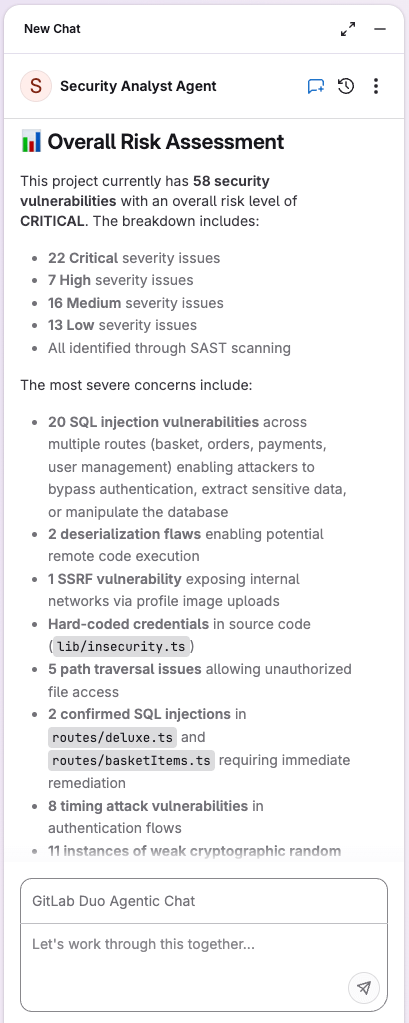
Security analyst agent summary.
Published: